
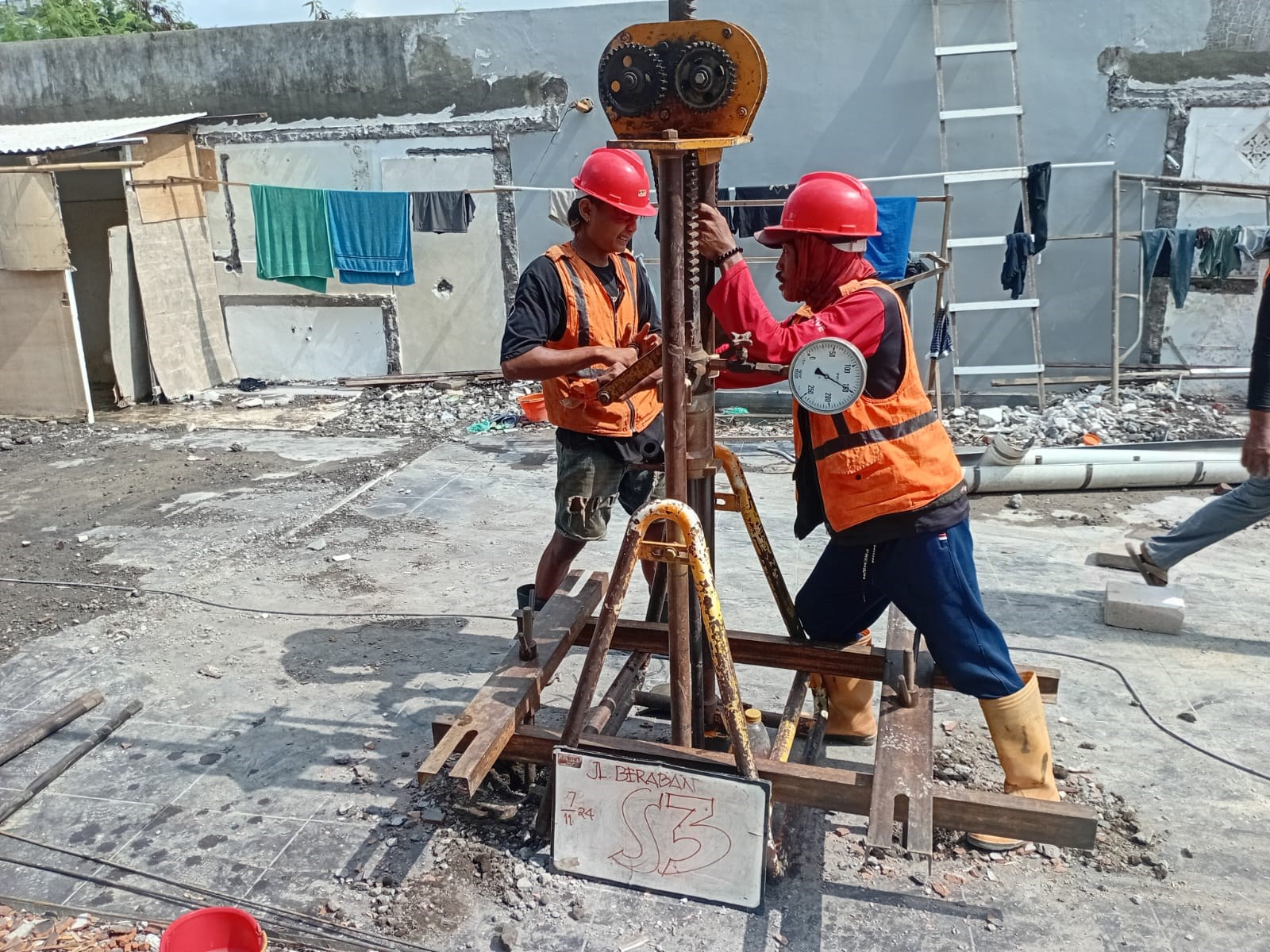
If you are planning to build in Bali, understanding the soil testing methods used in Bali is one of the most important steps you can take before construction begins. Soil conditions across Bali vary dramatically, from soft coastal alluvium in Seminyak and Canggu to volcanic deposits inland and unstable cliff terrain in Uluwatu. Choosing the right soil testing method ensures your foundation is designed on accurate data, not assumptions.
Indonesia applies both national and international standards for geotechnical investigation. ASTM D5778-20, the standard for electronic friction cone and piezocone penetration testing, is widely referenced by professional geotechnical firms across the country. Understanding each method helps you ask the right questions and make smarter decisions when you engage a soil testing service.
#1: Cone Penetration Test (CPT) or Sondir
The Cone Penetration Test, locally known as Sondir, is the most widely used soil testing method in Bali. A cone-tipped rod is pushed steadily into the ground, and sensors measure tip resistance and sleeve friction at every depth. This produces a continuous, high-resolution soil profile without the need to extract physical samples.
According to ASTM D5778-20, the electronic friction cone penetration test provides a rapid means of determining subsurface conditions and is used to evaluate site stratigraphy, bearing capacity, and depth to firm soil layers. It is particularly valuable for soft to medium soils, which are common across coastal Bali.
Indo Soil uses digital CPT equipment, which delivers significantly more reliable data than older mechanical systems. The electronic cone records measurements continuously and in real time, giving your structural engineer the precise depth profile needed to design safe foundations.
Understanding CPT: Function and Procedure in Bali
Electromechanical vs Mechanical Sondir CPT in Bali
#2: Standard Penetration Test (SPT) or Boring Test
The Standard Penetration Test (SPT) involves drilling a borehole and driving a split-barrel sampler into the soil at regular intervals. Each interval produces both a physical soil sample and an N-value, which reflects the soil’s resistance to penetration. This is one of the most established soil testing methods used in Bali for deeper investigations.
ASTM D1586/D1586M describes the SPT as the most frequently used subsurface exploration drilling test performed worldwide. Numerous international and national standards are in general conformance with this method, and it provides samples that can be used for laboratory identification and engineering design.
This method is mandatory for multi-storey buildings, bridges, resort developments, and any project requiring deep foundation design. Indo Soil conducts boring tests up to 30 metres in depth and delivers certified reports in English and Bahasa Indonesia with full laboratory analysis.
#3: Soil Laboratory Testing
Laboratory testing analyses the physical and mechanical properties of soil samples collected during boring. This includes moisture content, Atterberg limits, particle size distribution, shear strength, and consolidation behaviour. Each of these parameters directly informs foundation design and load-bearing calculations.
Laboratory tests are conducted on samples taken from SPT boreholes and provide data that cannot be obtained through field tests alone. According to the ISSMGE Technical Committees, laboratory testing remains essential for projects on soft, compressible, or variable soils, where field tests may not capture the full behaviour of the ground under load.
Indo Soil partners with accredited geotechnical laboratories to ensure all results are traceable, precise, and fit for submission to engineers and local authorities. Laboratory testing is included in all projects that require boring work.
Professional Soil Test Bali: Sampling Procedures Explained
Soil Testing, Soil Strength, and Types of Soil
#4: Geoelectric Survey (Electrical Resistivity)
Geoelectric surveying measures the electrical resistivity of the ground to map subsurface layers non-invasively. Different soil and rock types conduct electricity at different rates, allowing engineers to identify aquifers, cavities, soft zones, and geological boundaries without drilling. This method is one of the most effective complementary soil testing methods used in Bali for complex or large sites.
The ISSMGE recognises electrical resistivity profiling as a validated geophysical method for geotechnical site characterisation, particularly for identifying voids and variable subsurface conditions. For cliff-side and limestone terrain in areas like Uluwatu and Pecatu, this method adds significant value before drilling begins.
Indo Soil uses 1D, 2D, and 3D resistivity models depending on the site requirements. The geoelectric survey is commonly combined with CPT data to produce a comprehensive subsurface picture that guides both foundation and drainage design.
Geotechnical Analysis for Luxury Cliff Villas in Bali
Soil Test Investigation: Pecatu, South Kuta, Bali
#5: Ground Penetrating Radar (GPR) Survey
Ground Penetrating Radar uses high-frequency electromagnetic pulses to detect buried objects, utilities, voids, and structural features within the shallow subsurface. It is a rapid, non-invasive method that is particularly valuable on sites with existing infrastructure or where subsurface cavities are suspected.
GPR is standardised under ASTM D6432, which covers the use of surface ground penetrating radar for subsurface investigation. This method is commonly applied in Bali for utility detection before excavation, concrete slab inspection, and mapping of buried structures on heritage or mixed-use development sites.
Indo Soil provides GPR surveys as a standalone service or as part of a multi-method investigation package. The results are delivered alongside CPT or geoelectric data to give you the most complete view of your site conditions before any work begins.
Not Sure Which Method Your Project Needs?
Talk to the Indo Soil team for a free consultation. We will recommend the right combination of soil testing methods based on your site location and building type. Serving Bali, Lombok, NTB, and NTT.
Comparison Table: Soil Testing Methods Used in Bali
The table below summarises the five main soil testing methods used in Bali and helps you identify which approach suits your project type and site conditions.
| Method | Depth Range | Best For | Standard Reference | Sample Obtained |
|---|---|---|---|---|
| CPT / Sondir | 0 to 30 m | Soft soil profiling, liquefaction assessment, quick site screening | ASTM D5778-20 | No (in-situ data only) |
| SPT / Boring Test | 5 to 30+ m | Deep foundation design, multi-storey buildings, lab sampling | ASTM D1586/D1586M | Yes (split-barrel sampler) |
| Soil Laboratory Testing | Based on sample depth | Shear strength, consolidation, Atterberg limits, classification | ISSMGE Standards | Yes (from boring) |
| Geoelectric Survey | 0 to 50 m | Aquifer detection, cavity mapping, large-scale site screening | ISSMGE | No (geophysical data) |
| GPR Survey | 0 to 5 m | Utility mapping, void detection, buried object identification | ASTM D6432 | No (radar imaging) |
How to Choose the Right Soil Testing Method
Selecting the appropriate soil testing method in Bali depends on three main factors: your project type, your site location, and the depth of your planned foundation. A small villa on flat inland ground may only require a standard CPT. A cliff-edge resort or a multi-storey commercial development, on the other hand, will need a combination of CPT, boring, and possibly geoelectric or GPR surveys.
According to the USGS, CPT data can be used to infer soil type and resistance to liquefaction, making it especially important in seismically active regions such as Bali and Lombok. If your land is near the coast or in a zone with high earthquake risk, your engineer should specify a CPT with pore pressure measurement at minimum.
For projects requiring a building permit (PBG or SLF), geotechnical documentation is a formal submission requirement. Indo Soil provides certified reports in English and Bahasa Indonesia, in both PDF and CAD formats, within 5 to 7 working days.
What Is a Soil Test? A Basic Guide Before You Build
How to Determine Optimal CPT Test Point Spacing in Bali
What Every Bali Property Investor Must Know About Soil Conditions
Indo Soil Service Pricing
The table below reflects standard service packages from Indo Soil. All packages include a certified geotechnical report delivered within 5 to 7 working days, with no hidden costs.
| Package | Price (IDR) | Includes | Best For |
|---|---|---|---|
| Basic Soil Test | Rp 4,000,000 | 3 CPT points (0 to 5 m), PDF report, foundation recommendation in English and Bahasa Indonesia | Small villas, initial planning |
| Business Starter | Rp 7,500,000 | CPT 3 points + topographic survey, full technical report in PDF and CAD (DWG) format | Commercial and mid-size developments |
| Topographic Survey | Rp 4,500,000 | GPS/Total Station survey, DWG + PDF output, benchmark points, contour and cross-section data | Slope, drainage, and layout planning |
| Custom / Large Projects | Contact for quote | Boring test, geoelectric survey, GPR, slope stability analysis, full multi-method package | Resorts, cliff sites, complex terrain, infrastructure |
Why the Right Method Matters for Your Project in Bali
Bali presents uniquely varied soil conditions. Coastal zones such as Seminyak, Berawa, and Canggu contain soft saturated alluvium with low bearing capacity and high liquefaction risk. Cliff sites in Uluwatu, Pecatu, and Nusa Dua involve shallow rock, tension cracking risk, and unpredictable cavity formation. Inland and highland areas such as Ubud and Petang have volcanic deposits that vary significantly in compressibility.
Each of these conditions demands a different soil testing method or combination of methods. As noted by the USGS Earthquake Hazards Program, the CPT allows engineers to identify subsurface conditions in the upper layers of the ground that directly affect structural performance during seismic events. This is directly relevant to construction anywhere in Bali and eastern Indonesia.
Indo Soil has completed over 100 projects and surveyed more than 3,000 hectares across Bali, Lombok, NTB, and NTT. Our engineers recommend the most appropriate method or combination based on your site, not a one-size-fits-all approach.
How Soil Testing Protects Your Property Investment in Bali
Ultimate Bali Soil Testing Guide for Coastal and Cliff Construction Projects
Soil Test and Slope Analysis in Carang Sari, Petang, Bali
Get a Free Consultation on Soil Testing Methods
Tell us about your land and project type. Indo Soil will recommend the most efficient and accurate combination of soil testing methods used in Bali for your specific needs. No commitment required.
Conclusion
Understanding the five main soil testing methods used in Bali, which are CPT/Sondir, SPT/Boring Test, laboratory testing, geoelectric survey, and GPR survey, gives you the knowledge to make informed decisions before construction begins. Each method serves a specific purpose, and the most effective investigations typically combine two or more approaches.
Conducting the right soil test is not simply a regulatory requirement. It is the foundation of every safe, durable, and cost-effective building project in Bali. Indo Soil is here to guide you through the process from site assessment to certified report delivery. Contact Indo Soil today for a free consultation and let us match the right method to your land.
Frequently Asked Questions
Q1: Which soil testing method is most commonly used in Bali?
The CPT or Sondir is the most widely used soil testing method in Bali because it is fast, cost-effective, and produces a detailed continuous soil profile. It is ideal for residential and small commercial projects where soft to medium soil conditions are expected. Indo Soil uses digital electronic CPT equipment for the highest data accuracy.
Q2: When do I need a boring test (SPT) instead of a CPT?
You need a boring test when your project involves multi-storey buildings, deep foundations, or sites with very stiff or rocky soil layers that a CPT cannot penetrate. The SPT also provides physical soil samples for laboratory analysis, which CPT does not. For most villa and resort developments in Bali, a combination of both methods gives the most complete data.
Q3: Is laboratory testing always required for soil investigations in Bali?
Laboratory testing is required when physical soil samples are collected during boring. It provides data on shear strength, consolidation, and soil classification that field tests alone cannot deliver. For projects requiring SLF or PBG permit documentation, laboratory test results are typically part of the geotechnical report submission.
Q4: What is the difference between geoelectric survey and GPR survey?
Geoelectric survey measures electrical resistivity to map deeper subsurface conditions such as aquifers and cavities, typically reaching depths of 30 to 50 metres. GPR uses radar signals to detect shallow buried objects and utilities within the top 5 metres. Both are non-invasive and are often used to complement drilling-based investigations on complex sites.
Q5: How long does it take to get soil testing results from Indo Soil?
Field testing for a standard CPT package at 3 points is typically completed in one working day on site. Report preparation and delivery takes 5 to 7 working days from the date of testing. Complex projects involving boring, laboratory testing, or multi-method investigations may require additional time, which Indo Soil will confirm at the time of engagement.
