
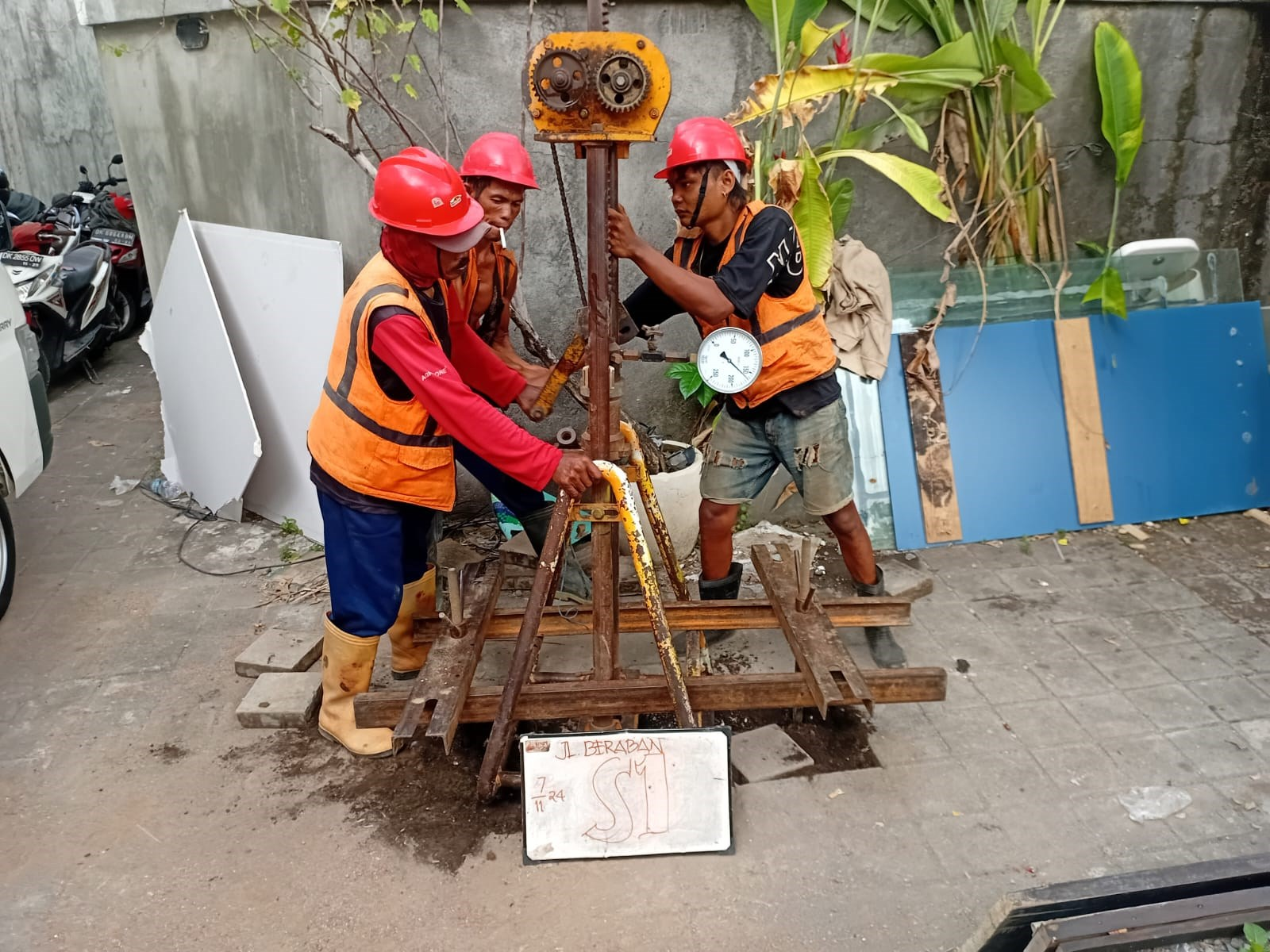
Every year, construction projects across Bali encounter serious foundation problems, and most of these situations share one common cause. Owners and developers begin building without conducting a proper soil test, and the consequences appear months or even years after completion. These are not minor inconveniences. They are structural failures, permit rejections, and financial losses that a single geotechnical investigation could have prevented entirely.
Bali’s soil conditions are highly variable. From soft alluvial deposits along the Seminyak and Canggu coastline to unstable volcanic layers in inland areas and limestone cavities beneath Bukit Peninsula cliffs, no two plots of land carry identical risk profiles. Understanding the most common mistakes building without soil test decisions create is the first step toward building safely and confidently.
According to GeoEngineer.org, there are two primary modes of foundation failure that engineers must design against: bearing capacity failure, which is abrupt and catastrophic, and excessive settlement, which causes structural cracking and serviceability problems over time. Both failures share a common root cause. Without accurate soil data, engineers cannot design to prevent either.
#1: Choosing a Foundation Type That Does Not Match the Soil
This is the most technically damaging of all mistakes building without soil test data creates. When your structural engineer does not have actual bearing capacity values, they either over-design at unnecessary cost, or under-design and risk settlement. Neither outcome protects you or your investment.
Shallow strip or pad foundations perform well on stiff soils with adequate bearing capacity. However, placing them on soft alluvial clay or loose coastal sand without soil test confirmation is a direct path to uneven settlement and structural cracking. According to GeoEngineer.org, a total foundation settlement of 2.5 centimetres is the common design threshold for isolated spread footings. Exceeding this figure leads to visible damage across the structure.
A CPT or Sondir test from Indo Soil delivers the bearing capacity profile your engineer needs at every depth, so the foundation type selection is based on verified data rather than assumption.
Understanding CPT: Function and Procedure in Bali
Soil Testing: Soil Strength and Types of Soil
#2: Widely Off-Target Cost Estimates
One of the most financially painful mistakes building without soil test analysis leads to is a budget that collapses partway through construction. Contractors price their work based on assumed soil conditions. When those assumptions turn out to be wrong, the cost of redesigning foundations, sourcing longer piles, or remediating soft ground hits your project budget without warning.
A soil test is not an additional expense. It is a risk management tool that eliminates one of the largest sources of budget uncertainty in any construction project. Developers who obtain geotechnical data before finalising their bill of quantities consistently report fewer cost variations during construction than those who skip this step.
Indo Soil’s Basic Soil Test package starts at Rp 4,000,000 and delivers a complete CPT report with foundation recommendations within 5 to 7 working days. That cost is a fraction of what a single foundation revision during construction typically requires.
#3: Building Subsides or Tilts After Completion
Differential settlement is one of the most destructive outcomes of the mistakes building without soil test guidance can prevent. When one part of a structure settles faster or deeper than another, the entire building experiences unequal vertical displacement. The result is visible wall cracks, sloping floors, sticking doors and windows, and in severe cases, structural compromise.
According to research published via GeoEngineer.org, foundation settlement is not always sudden or catastrophic. Gradual shifts can lead to cracked walls, sloping floors, and overstressed structural elements. The problem develops quietly and becomes expensive to address after the structure is complete.
Moreover, as GeoEngineer.org states, when one side of a building settles more than the other (differential settlement), the construction will suffer crucial damage. A soil test before construction reveals the variability across your plot so your engineer can design accordingly.
10 Fatal Mistakes That Happen Without Soil Testing
What Every Bali Property Investor Must Know About Soil Conditions
#4: Rejected During PBG and SLF Application
Many developers discover this particular mistake only after investing significant time and money into their project. Among all the mistakes building without soil test documentation creates, this one causes the most direct operational delay. Without a certified geotechnical report, your PBG (Building Approval) and SLF (Certificate of Occupancy) applications lack a mandatory technical document, and local authorities will reject the submission.
The requirement for geotechnical data in building permit applications is not a bureaucratic formality. It is aligned with international practice. According to Eurocode 7 (EN 1997-1), the standard for geotechnical design applied to buildings and civil engineering works globally, geotechnical investigations are a mandatory precondition for design verification, not an optional addition.
Indo Soil provides certified soil test reports accepted by local permitting authorities across Bali, Lombok, NTB, and NTT. Each report is delivered in both English and Indonesian, in PDF format, within 5 to 7 working days.
Need a Report for Your PBG or SLF Application?
Indo Soil delivers certified geotechnical reports accepted by local authorities. Contact us today for a free consultation on your project needs.
#5: Suboptimal Structural Design Based on Assumptions
When your structural engineer works without geotechnical data, they rely on regional assumptions or conservative estimates to fill the gap. This approach does not produce optimal designs. It produces either over-engineered structures that consume unnecessary materials and budget, or under-engineered ones that carry hidden risk.
The mistakes building without soil test data most often creates in structural design involve incorrectly sized pile caps, insufficient pile length, and mismatched load distribution across footings. Each of these errors costs money to identify and substantially more to correct. Accurate soil data enables engineers to size foundations precisely, select pile types correctly, and confirm that the structure’s load path aligns with what the ground can actually support.
Indo Soil reports include bearing capacity values at each test depth, soil stratification profiles, and specific foundation type recommendations. Your structural engineer receives what they need to produce a design that is both safe and cost-efficient from the start.
Professional Soil Test Bali: Sampling Procedures Explained
How Well Do Soil Test Recommendations Match Field Conditions in Bali?
#6: Wall Cracks Appearing Within the First One to Two Years
Wall cracks in a newly completed building are among the most visible consequences of the mistakes building without soil test data avoids. When clients see cracks forming in walls, tiles lifting, or floor levels shifting within the first two years after construction, the underlying cause is almost always differential settlement from an inadequately investigated or improperly designed foundation.
These cracks are not cosmetic issues. As research available through GeoEngineer.org notes, gradual shifts in foundation position lead to overstressed structural elements that affect the long-term performance of the entire building. Addressing this problem after completion requires structural retrofitting, underpinning, or in severe cases, partial demolition.
The financial and reputational cost of post-construction remediation far exceeds the cost of a pre-construction soil test. Indo Soil has served clients across Bali, Lombok, NTB, and NTT, and the pattern is consistent: projects with geotechnical data before design show significantly fewer post-construction issues.
How to Avoid Contractor Disputes Caused by Soil Issues in Bali
Soil Test Investigation for a Residential Project in Canggu
#7: Loss of Investor or Buyer Confidence
Beyond physical damage, the mistakes building without soil test documentation creates extends into the commercial value of your property. Investors conducting due diligence on a Bali development project expect to see a geotechnical report as part of the technical documentation package. Buyers of completed villas or commercial units ask whether foundation design was based on actual soil data.
A missing or inadequate soil test report signals either ignorance or risk-taking to any sophisticated buyer or investor. In a competitive market where Bali attracts international capital, this perception gap can directly affect your sale price, financing options, or investor confidence.
Commissioning a professional soil test from the outset positions your project as well-managed, technically sound, and compliant with both local permitting requirements and international engineering standards referenced in Eurocode 7. That documentation becomes a marketable asset throughout the project lifecycle.
Geotechnical Analysis for Luxury Cliff Villas in Bali
Soil Test for North Bali Property Investment 2026
Soil Test Investigation: Pecatu, South Kuta, Bali
Avoid All Seven Mistakes with One Decision: Contact Indo Soil
All seven of these mistakes building without soil test data leads to are entirely preventable. The solution is not complicated. A professional soil investigation conducted before your structural engineer begins foundation design eliminates every single risk outlined in this article.
Indo Soil is a geotechnical services company based in Bali, serving projects across Bali, Lombok, NTB, and NTT. Our services include CPT/Sondir testing, Boring Test (SPT), topographic survey, geoelectric survey, Ground Penetrating Radar, and slope stability analysis. We have completed over 100 projects and surveyed more than 3,000 hectares of land for private owners, developers, and government agencies.
Every report we deliver includes a full soil stratification profile, bearing capacity data, and specific foundation recommendations. Reports are produced in English and Indonesian, in PDF and CAD formats, and delivered within 5 to 7 working days. Our pricing is fully transparent with zero hidden costs.
Why Clients Choose Indo Soil for Soil Testing in Bali
Ultimate Bali Soil Testing Guide for Coastal and Cliff Construction
Soil Test for Berawa Signature Project, Canggu
Soil Test Service Packages from Indo Soil
| Service Package | Price (IDR) | Includes | Suitable For |
|---|---|---|---|
| Basic Soil Test | Rp 4,000,000 | 3 CPT points (0-5 m), PDF report, initial foundation recommendation | Small villas, early-stage planning |
| Business Starter | Rp 7,500,000 | 3 CPT points + topographic survey, PDF and CAD (DWG) output | Mid-scale commercial projects |
| Topographic Survey | Rp 4,500,000 | GPS/Total Station, DWG + PDF, benchmark points included | Slope, drainage, and layout planning |
| Custom / Large Projects | Contact for quote | Boring test, SPT, lab sampling, geoelectric, slope analysis | Resorts, cliff sites, multi-storey buildings |
Key Facts About Soil Testing for Bali Construction
| Fact | Detail | Why It Matters |
|---|---|---|
| Differential settlement limit | 2.5 cm for isolated spread footings | Exceeding this causes wall cracks and structural damage |
| CPT depth range | 0 to 30+ metres | Identifies bearing layer depth for foundation pile design |
| PBG/SLF requirement | Geotechnical report is mandatory | Applications without valid report are rejected by authorities |
| Report delivery time | 5 to 7 working days (Indo Soil) | Fits within standard project design timelines |
| Bali soil variability | Alluvial, volcanic, limestone zones | Surface appearance does not indicate subsurface conditions |
| Standard reference | Eurocode 7 EN 1997 / ASTM D5778-20 | International standards guide all valid soil investigation work |
One Decision. Seven Problems Prevented.
Contact Indo Soil today for a free consultation. We will assess your land, recommend the right investigation method, and deliver your report within 5 to 7 working days.
Conclusion
The seven mistakes building without soil test data leads to are not isolated incidents. They represent a predictable pattern that repeats itself on construction sites across Bali wherever geotechnical investigation is skipped or delayed. Foundation mismatches, budget overruns, differential settlement, permit rejections, structural cracks, suboptimal design, and investor confidence loss are all direct outcomes of the same avoidable decision.
A professional soil test is the single most cost-effective investment you can make before breaking ground. It provides the foundational data your entire design and construction team needs to do their jobs accurately. Indo Soil makes that process fast, transparent, and reliable.
Contact Indo Soil today and let our team design the right investigation programme for your land before your project begins.
Frequently Asked Questions
Q1: Can I build without a soil test in Bali if my land looks flat and stable?
No. Surface appearance has no reliable relationship with subsurface soil conditions. Flat land in coastal Bali can conceal deep layers of soft compressible clay, a high water table, or loose fill that will settle after loading. A soil test is the only accurate way to determine what lies beneath your plot. Learn what a soil test actually reveals here.
Q2: Is a soil test report mandatory for a PBG or SLF application in Bali?
Yes. Geotechnical documentation is a required component of technical submissions for building permits (PBG) and occupancy certificates (SLF) in Indonesia. Applications submitted without a valid soil test report from a certified geotechnical firm will be returned by local authorities. Indo Soil produces reports accepted across all regencies in Bali, Lombok, NTB, and NTT.
Q3: How long does it take to get a soil test report from Indo Soil?
Field testing at three standard CPT points is typically completed within one working day. Your complete written report, including soil profile, bearing capacity data, and foundation recommendations in both English and Indonesian, is delivered within 5 to 7 working days from the test date.
Q4: What are the signs that a building was constructed without adequate soil investigation?
Common indicators include wall cracks appearing within the first one to two years, uneven floor levels, doors and windows that no longer align properly, visible tilting of the structure, and subsidence visible along the perimeter. These symptoms typically indicate differential settlement caused by an inadequately designed foundation. See the full list of consequences here.
Q5: Does Indo Soil serve areas outside of Bali?
Yes. Indo Soil provides soil testing, boring test, topographic survey, geoelectric, and GPR services across Bali, Lombok, NTB, and NTT. Our team has completed projects in more than 20 locations across these regions for private property owners, developers, architects, and government agencies. View our full service coverage here.
Yoast SEO:
Title:
