
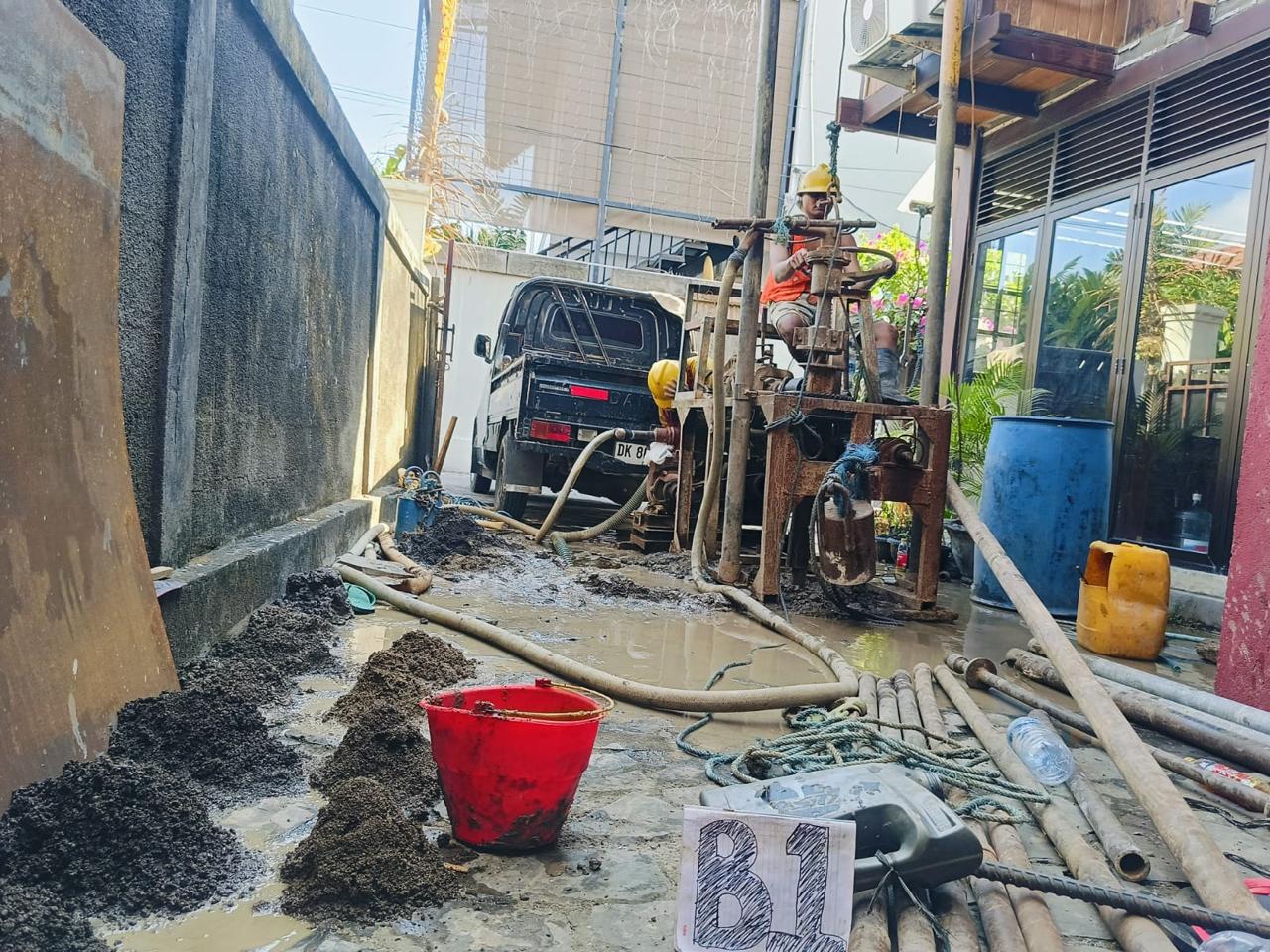
You have just received a soil test Bali report from your geotechnical engineer, and the numbers look unfamiliar. Graphs pointing in different directions, tables full of values like qc, fs, and N-SPT, and a recommendations section that references foundation depths you have never heard of before.
This guide is written specifically for land owners in Bali who are not engineers. By the end, you will know exactly what to look for in your soil test Bali report, what the key values mean, and what questions to ask before your project moves forward.
A soil test Bali report is a formal geotechnical document produced after field testing such as a CPT (Cone Penetration Test) or SPT (Standard Penetration Test). According to ASTM D5778-20, the CPT measures tip resistance and sleeve friction at every centimetre of soil depth, giving engineers a detailed picture of what lies beneath your land. Understanding this data protects your investment and keeps your build on the right track.
Why Land Owners in Bali Need to Understand Their Soil Test Report
A soil test Bali report is not just a document for engineers. It is a record that affects every decision your architect, structural engineer, and contractor will make about your building’s foundation.
When you understand the basics of your report, you are in a stronger position to ask the right questions, catch inconsistencies, and verify that the foundation design actually matches the soil conditions found on your land. According to the ISSMGE Technical Committee on In-Situ Testing (TC102), in-situ test data such as CPT results are directly used to interpret subsurface stratigraphy and engineering properties for foundation design. Knowing how to read this data puts you, the land owner, in control.
Bali’s soil conditions vary enormously across districts. Coastal areas in Seminyak and Canggu often contain soft alluvial deposits, while cliff zones in Uluwatu and Pecatu sit above limestone formations. A single soil test Bali report will reflect all of this, and your ability to read it matters.
Main Sections of a Soil Test Report
Every soil test Bali report from a professional geotechnical firm follows a consistent structure. Knowing what each section contains helps you navigate the document quickly and focus on what matters most.
A complete report includes: an executive summary, a site description, the methodology used, field test results, data interpretation, and the engineering recommendations. The most important sections for a land owner to read first are the executive summary and the recommendations. These two sections give you the overall picture in plain language before you dive into the technical graphs and tables.
The site description confirms the location and number of test points conducted on your land. The methodology section states which test was performed, such as CPT per ASTM D5778 or SPT per ASTM D1586, so you know the data is based on a recognised international standard.
| Report Section | What It Contains | Who Uses It | Land Owner Priority |
|---|---|---|---|
| Executive Summary | Overall site verdict, key findings | All parties | Read first |
| Site Description | Location, test points, site conditions | Engineers, contractors | Confirm it matches your land |
| Methodology | Test type, equipment, standard used | Engineers | Check standard reference |
| Test Results | CPT graphs, SPT tables, raw data | Geotechnical engineers | Use this guide to read it |
| Interpretation | Soil layer descriptions, bearing values | Structural engineers | Look for soft layer warnings |
| Recommendations | Foundation type, depth, load limits | Architects, contractors | Read carefully and confirm |
How to Read the CPT or Sondir Graph
The CPT graph is the visual core of your soil test Bali report. It looks like a chart turned on its side, with depth on the vertical axis (going downward) and resistance values on the horizontal axis.
The key value to understand is qc, which stands for cone tip resistance and is measured in kg/cm² or MPa. A high qc value means the soil is hard and dense. A low qc value means the soil is soft and compressible. The FHWA Geotechnical Engineering Circular No. 5 describes cone penetration testing as one of the most reliable methods for evaluating site stratigraphy and estimating soil engineering properties.
As a land owner, the most important thing to locate on the graph is the depth at which qc values become consistently high, typically above 150 kg/cm². That depth indicates the start of the hard soil layer, which is the target bearing layer for your foundation piles. Any soft layers above that point, where qc drops below 50 kg/cm², are zones your engineer must account for in the foundation design.
Understanding CPT: Function and Procedure in Bali
Electromechanical vs Mechanical Sondir CPT in Bali
Understanding the SPT Table in Your Soil Test Report
If your soil test Bali report includes a boring test, you will see an SPT table alongside or instead of the CPT graph. The SPT, or Standard Penetration Test, is defined under ASTM D1586 and produces an N-value at each test depth, typically taken every 1.5 metres.
The N-value represents the number of blows required to drive a standard sampler 300mm into the ground. A low N-value (below 10) indicates very soft or loose soil. An N-value above 30 to 50 indicates dense or stiff soil with good bearing capacity. The SPT table in your report will list depth, N-value, and often a soil description such as sandy clay, silty sand, or gravelly fill.
When reading the SPT table, look for any layer where the N-value is very low at a shallow depth. This is a warning sign that the soil near the surface cannot carry building loads without settlement, and your foundation must reach deeper, more stable layers.
Interpreting Soil Bearing Capacity Values
One of the most important figures in your soil test Bali report is the allowable bearing capacity, written as qa or qallowable. This value tells you the maximum load per square metre that the soil can safely support.
The allowable bearing capacity is calculated from the raw CPT or SPT data after applying a safety factor, typically between 2.0 and 3.0 as recommended by the ISSMGE In-Situ Testing standards. This means the soil can actually carry more load than the qa value states, but the safety margin protects against uncertainties in the ground conditions.
As a land owner, verify that the structural load per square metre of your planned foundation does not exceed the qa value stated in the report. If your architect or structural engineer proposes a foundation design that requires a bearing capacity higher than what the report states, that is a red flag that needs to be resolved before construction begins.
Not Sure What Your Report Says? Talk to the Indo Soil Team Now.
We explain every section of your soil test report in plain language, at no charge. Indo Soil serves land owners across Bali, Lombok, NTB, and NTT.
Reading the Foundation Recommendations Section
The recommendations section is where the geotechnical data translates into actionable guidance for your build. A complete soil test Bali recommendations section will specify: the recommended foundation type, the minimum foundation depth, the allowable pile load capacity, and any soil improvement required before construction.
According to Eurocode 7 (EN 1997-1), which governs geotechnical design standards internationally, foundation recommendations must be based on a sufficient ground investigation and must consider both the strength and deformation characteristics of the soil. A well-prepared Indo Soil report reflects these requirements in a format that both engineers and land owners can follow.
When reviewing your recommendations, confirm three things: the recommended foundation type matches the scale of your building, the stated foundation depth reaches the hard soil layer identified in the CPT or SPT data, and the report includes a pile load capacity figure that your structural engineer can use directly in design calculations.
Professional Soil Test Bali: Sampling Procedures Explained
Geotechnical Analysis for Luxury Cliff Villas in Bali
Indo Soil Service Packages and Pricing
Understanding what you are getting before you commission a soil test Bali service helps you plan your project budget accurately. The table below outlines Indo Soil’s current service packages, all of which include a certified bilingual report delivered within 5 to 7 working days.
| Package | Price (IDR) | Includes | Best For |
|---|---|---|---|
| Basic Soil Test | Rp 4,000,000 | 3 CPT points (0-5 m), PDF report in English and Bahasa Indonesia, foundation recommendation | Small villas, initial site planning |
| Business Starter | Rp 7,500,000 | CPT 3 points plus topographic survey, PDF and CAD (DWG) output, full technical report | Commercial projects and mid-size developments |
| Topographic Survey | Rp 4,500,000 | GPS/Total Station survey, DWG and PDF output, benchmark points, spot levels | Slope planning, drainage design, cut and fill |
| Custom Large Projects | Contact for quote | Boring test (SPT), geoelectric survey, GPR, slope stability analysis | Resorts, cliff sites, complex terrain |
Questions You Should Ask the Indo Soil Team After Receiving Your Report
Once you have reviewed your soil test Bali report using this guide, the next step is to confirm your understanding with the Indo Soil team directly. Asking the right questions ensures there are no gaps between the data and your construction plan.
Useful questions include: Does the recommended foundation type match the number of storeys I am planning? At what depth did the hard soil layer begin, and does the pile length in my structural drawings match that depth? Are there any problematic soil layers in my report that could cause settlement after construction? What is the maximum load per square metre the soil can carry at the recommended foundation depth?
The Indo Soil team is trained to explain reports in clear, accessible language for non-technical land owners. You do not need an engineering background to ask these questions. You simply need to know your project scope and compare it against what the report recommends.
How Soil Testing Protects Your Property Investment in Bali
What Every Bali Property Investor Must Know About Soil Conditions
Conclusion
Reading a soil test Bali report does not require an engineering degree. It requires knowing which sections to prioritise, what the key values mean, and how those values connect to the foundation design for your building. The executive summary and recommendations section give you the overall picture. The CPT graph and SPT table give you the subsurface detail. The bearing capacity values tell you the limits your foundation must respect.
Indo Soil is committed to delivering every soil test Bali report in a format that is clear, bilingual, and usable by all parties, from engineers and architects to land owners who are building for the first time. Every data point in your report has a purpose, and understanding it puts you in control of your construction project from the very start.
Contact Indo Soil today for a free report consultation. Our team will walk through your soil test findings with you and confirm that your construction plan is fully aligned with what the ground beneath your land can support.
Frequently Asked Questions
Q1: What is the most important value to look for in a soil test Bali report?
The allowable bearing capacity (qa) is the single most important value for a land owner. It tells you the maximum load per square metre your soil can safely carry. Your structural engineer’s foundation design must not exceed this value. If it does, the foundation design needs to be revised before construction begins.
Q2: What does a low qc value on my CPT graph actually mean?
A low qc value, typically below 50 kg/cm², indicates soft or loose soil at that depth. This means the soil at that layer has weak bearing capacity and is susceptible to compression and settlement under building loads. Your foundation must bypass this layer and reach the deeper, harder soil where qc values are consistently high.
Q3: How do I know if the foundation recommendation in my report is correct for my building?
Compare the recommended foundation depth in the report against the depth at which the CPT graph or SPT table shows consistently high resistance values. These should match. Also confirm that the recommended foundation type, whether a shallow spread footing or deep pile, is appropriate for the number of floors and total building load you are planning.
Q4: My report mentions a safety factor. What does that mean for me?
A safety factor is applied to the raw soil strength data to produce the allowable bearing capacity figure. According to FHWA GEC No. 5, safety factors in geotechnical design typically range from 2.0 to 3.0. This means your soil can physically carry two to three times more load than the report’s qa value states. The safety margin accounts for variations in soil, construction tolerances, and long-term settlement.
Q5: Can I use the same soil test report for multiple buildings on the same land?
It depends on the size of your land and the number of test points conducted. A soil test Bali report is valid for the specific test point locations. If you are planning buildings in different areas of a large plot, additional test points may be needed to ensure the data covers all foundation locations. Learn more about optimal CPT point spacing in Bali.
