
When planning a construction project in Bali, one of the most common questions you will face is which soil testing method to choose. The CPT vs SPT Bali comparison is not simply a technical debate. It directly affects your project timeline, budget, and the quality of geotechnical data your structural engineer receives before designing your foundation.
Both the Cone Penetration Test (CPT) and the Standard Penetration Test (SPT) are internationally recognised methods for subsurface investigation. However, they serve different purposes, produce different outputs, and suit different site conditions. Understanding their differences helps you make a smarter decision from the very start of your project.
According to GeoEngineer.org, supported by the American Society of Civil Engineers (ASCE) Geo-Institute, the CPT is capable of producing six to seven simultaneous measurements in a single sounding, providing an improved understanding of soil behaviour and groundwater conditions that point-based tests cannot match alone.
A Quick Look at CPT and SPT
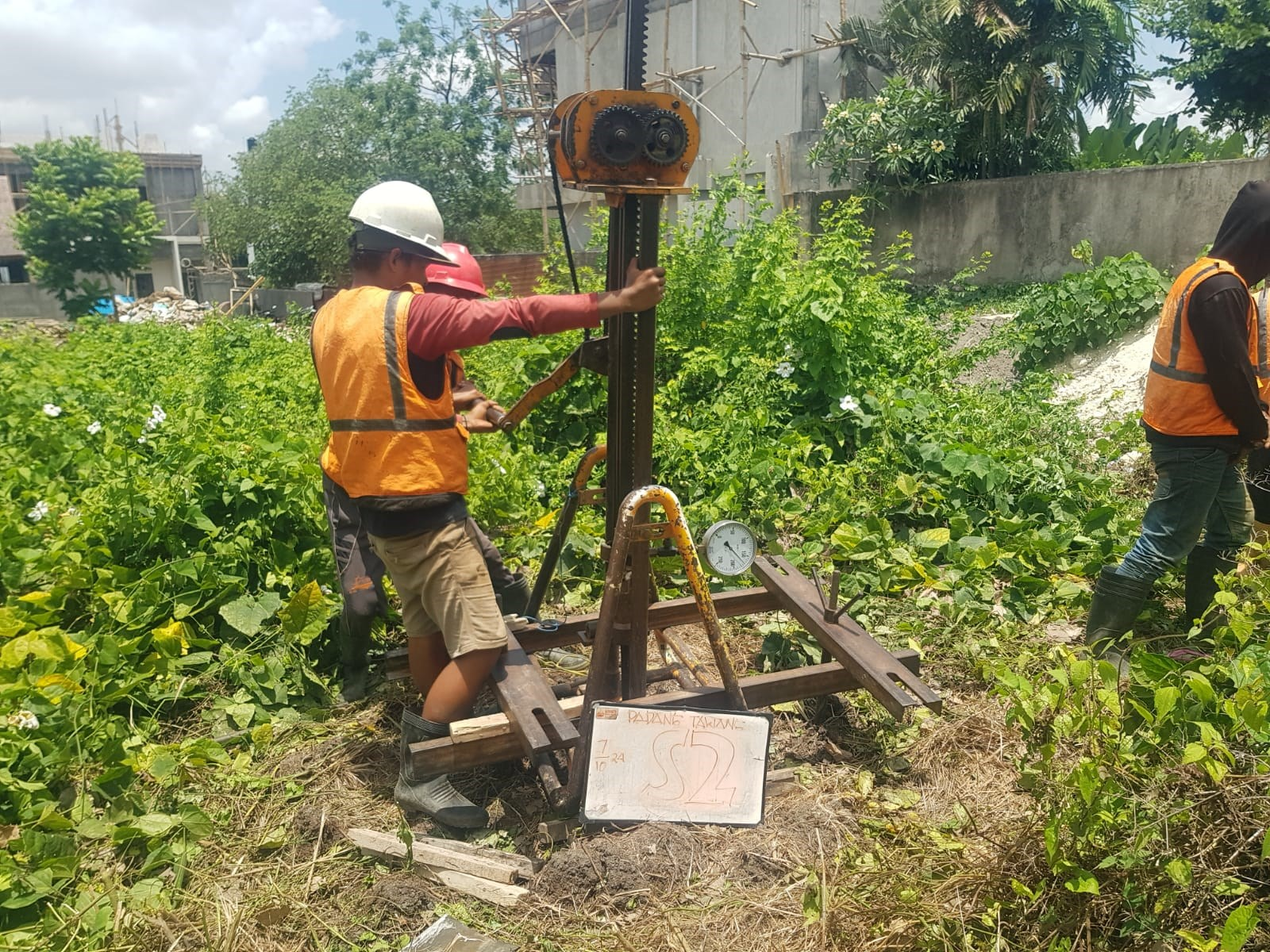
The Cone Penetration Test (CPT), also known as Sondir in Indonesia, involves pushing a cone-tipped electronic probe into the ground at a controlled rate. It records resistance data continuously at every depth without extracting soil samples. The result is a high-resolution, uninterrupted soil profile from the surface to the target depth.
The Standard Penetration Test (SPT), governed by ASTM D1586/D1586M, works differently. A split-barrel sampler is driven into the ground using a standard drop hammer inside a borehole. The number of blows required to drive the sampler 30 centimetres is recorded as the N-value. Critically, SPT also retrieves physical soil samples for laboratory analysis.
Both methods are valid tools in geotechnical engineering. The key is knowing which one your site and project type actually requires.
Understanding CPT: Function and Procedure in Bali
Boring Test Guide: Procedure and Foundation Interpretation
Technical Differences and Procedures
From a procedural standpoint, CPT and SPT differ significantly in how they operate and what they produce. CPT pushes a probe hydraulically at a constant rate of 2 centimetres per second, collecting continuous readings of tip resistance, sleeve friction, and pore water pressure. According to research published via GeoEngineer.org, CPT soundings can reach depths of up to 30 metres in approximately one to one and a half hours, with data logged directly to a field computer.
SPT, by contrast, requires a borehole to be drilled first. Testing occurs at 1.5-metre intervals rather than continuously. This means you receive data at discrete points rather than a complete profile. However, SPT retrieves actual soil samples that can be sent to a laboratory for index testing, moisture content, grain size analysis, and other characterisation procedures.
The table below summarises the core technical differences between the two methods.
| Aspect | CPT / Sondir | SPT / Boring Test |
|---|---|---|
| Data Type | Continuous profile at every depth | Discrete N-values at 1.5 m intervals |
| Soil Sample | None (non-destructive) | Yes, disturbed samples retrieved |
| Speed | Fast, 3 points completed in one day | Slower, one borehole per day typically |
| Depth Range | 0 to 30+ metres | 5 to 30+ metres |
| Best Soil Type | Soft to medium soils, alluvial, coastal | All soil types including rock and gravel |
| Standard Reference | ASTM D5778-20 | ASTM D1586/D1586M |
| Laboratory Analysis | Not applicable | Yes, samples available for lab testing |
CPT Advantages for Small to Medium Projects in Bali
For residential villas, boutique hotels, and small commercial structures up to three storeys, CPT is generally the most practical and cost-effective choice. The method is fast, generates detailed continuous data, and produces results that your structural engineer can use immediately to determine shallow foundation depths and bearing capacity values.
According to a publication available through GeoEngineer.org, the CPT has major advantages over traditional drilling and sampling methods because it is fast, repeatable, and economical. Furthermore, it provides near-continuous data and has a strong theoretical background, which has led to its steady adoption worldwide.
In Bali specifically, soft alluvial soils in coastal areas such as Canggu, Seminyak, and Kerobokan respond very well to CPT investigation. The continuous profile clearly reveals the depth at which the bearing layer begins, which is the critical data point for foundation pile design in these zones.
Ultimate Bali Soil Testing Guide for Coastal and Cliff Construction Projects
Soil Test for Berawa Signature Project, Canggu
SPT Advantages for Large and Complex Projects
For larger structures such as multi-storey resorts, commercial buildings above four storeys, or any project where deep foundations are planned beyond 20 metres, SPT becomes the preferred or even mandatory method. The physical soil samples it retrieves allow your geotechnical team to perform laboratory testing that CPT cannot provide.
According to GeoEngineer.org, SPT is one of the most widely used subsurface exploration drilling tests globally, and the N-value results provide the quantitative basis for many foundation capacity calculations and liquefaction assessments.
In challenging terrain such as Uluwatu cliff sites or volcanic rock zones in Kintamani, SPT combined with borehole drilling can penetrate layers that CPT equipment may not reach due to hard ground resistance. This makes SPT indispensable for projects in geologically complex areas.
Geotechnical Analysis for Luxury Cliff Villas in Bali
Soil Test Investigation: Pecatu, South Kuta, Bali
Cost Comparison for Bali Projects
Cost is a practical factor in every CPT vs SPT Bali comparison. CPT is generally more affordable per point because it requires less equipment, less time on-site, and no borehole preparation. SPT requires a drill rig, specialised operator, and additional time for drilling and sample retrieval, which raises the overall cost per test point.
However, the right question is not which method is cheaper in isolation, but which method produces the most useful data for your specific project type and budget. Spending slightly more on SPT when your project genuinely requires it will always cost less than redesigning a foundation after construction begins.
The table below provides a general cost comparison for Indo Soil services in Bali.
| Service Package | Price (IDR) | Includes | Suitable For |
|---|---|---|---|
| Basic Soil Test (CPT) | Rp 4,000,000 | 3 CPT points (0-5 m), PDF report, initial foundation recommendation | Small villas, early-stage planning |
| Business Starter (CPT + Topo) | Rp 7,500,000 | 3 CPT points + topographic survey, PDF and CAD (DWG) output | Mid-scale commercial projects |
| Topographic Survey Only | Rp 4,500,000 | GPS/Total Station, DWG + PDF, benchmark points | Slope, drainage, and layout planning |
| Custom / Large Projects (SPT) | Contact for quote | Boring test, SPT, lab sampling, slope analysis, geoelectric | Resorts, cliff sites, multi-storey buildings |
Not Sure Which Method You Need?
Talk to an Indo Soil expert today. We will assess your project type, site condition, and budget to recommend the most appropriate investigation method.
The Optimal Combination for Best Results
For mid-scale projects such as three to four storey villas, boutique resorts, or commercial buildings with deeper foundations, the most reliable approach is to combine both methods. A limited number of CPT soundings can efficiently map the overall soil profile across the site, while one or two SPT boreholes retrieve physical samples for laboratory confirmation.
According to Eurocode 7 (EN 1997-1), the standard for geotechnical design across Europe and increasingly adopted internationally, a complete geotechnical investigation should combine in-situ testing with laboratory testing where appropriate. This combined approach aligns directly with the CPT plus SPT methodology for complex projects.
Indo Soil designs combined investigation programmes based on the actual needs of each project. Your scope, site conditions, building height, and budget all factor into the recommendation we provide at zero cost during the initial consultation.
How to Determine Optimal CPT Test Point Spacing in Bali
Professional Soil Test Bali: Sampling Procedures Explained
Specific Bali Terrain and Which Method Applies
Bali’s diverse geology makes the CPT vs SPT Bali comparison particularly relevant for local property owners and developers. Different zones across the island present different soil challenges, and matching the right method to each terrain type is essential.
Coastal zones in Seminyak, Berawa, and Canggu typically feature soft to medium alluvial soils with a shallow water table. CPT performs exceptionally well in these conditions because the continuous data clearly identifies every soil layer transition down to the bearing stratum. Cliff-edge properties in Uluwatu and Pecatu, by contrast, often encounter shallow bedrock, variable limestone cavities, and tension crack zones near the slope crest. In these locations, SPT combined with geological mapping provides the depth, sample, and rock characterisation that CPT alone cannot deliver.
Soil Test and Slope Analysis in Carang Sari, Petang, Bali
Soil Test Investigation for a Residential Project in Canggu
Indo Soil Recommendation for Your Bali Project
After reviewing the full CPT vs SPT Bali comparison, the decision ultimately comes down to your specific project type, structure height, site terrain, and budget. Indo Soil has completed over 100 projects across Bali, Lombok, NTB, and NTT, including luxury cliff villas, coastal eco-resorts, and residential compounds.
Our expert team evaluates each site individually and recommends the most efficient investigation scope. We do not recommend unnecessary testing, and we do not apply a one-size-fits-all approach. Every report we produce is delivered in English and Indonesian, in both PDF and CAD formats, within 5 to 7 working days.
Whether you need CPT only, SPT only, or a combined programme, Indo Soil has the equipment, experience, and technical expertise to execute it accurately and professionally.
Why Clients Choose Indo Soil for Soil Testing in Bali
How Soil Testing Protects Your Property Investment in Bali
How Well Do Soil Test Bali Recommendations Match Field Conditions?
Get Your Free Consultation Today
Tell us about your site and we will recommend the right method. No commitment required. Indo Soil serves Bali, Lombok, NTB, and NTT.
Conclusion
The CPT vs SPT Bali comparison reveals that neither method is universally superior. CPT delivers fast, continuous, cost-effective soil profiling that is ideal for soft ground conditions and small to mid-scale projects. SPT provides physical soil samples and deeper penetration that larger and more complex structures genuinely require.
For most villa and boutique commercial projects in Bali, CPT is the first and most efficient step. For larger developments on complex terrain, combining both methods produces the most reliable geotechnical dataset. Indo Soil helps you navigate this decision with transparent advice, competitive pricing, and over a decade of experience across the region.
Contact Indo Soil today and let our team determine the best soil investigation approach for your project.
Frequently Asked Questions
Q1: Can CPT fully replace SPT for all projects in Bali?
Not always. CPT is ideal for profiling soft to medium soils and works very well for residential and small commercial projects. However, it cannot retrieve physical soil samples for laboratory analysis. For large structures, deep foundations, or sites with hard rock and gravel layers, SPT remains necessary. Learn more about CPT in Bali here.
Q2: How deep can CPT penetrate in Bali soil conditions?
In typical soft to medium Bali soils such as those found in coastal Canggu, Seminyak, and Kerobokan, CPT can reach depths of 20 to 30 metres. In harder ground such as limestone or compacted volcanic layers, penetration depth may be limited. Your Indo Soil engineer will assess the expected soil conditions before recommending the appropriate target depth.
Q3: Is SPT always more expensive than CPT in Bali?
Generally, yes, because SPT requires a drill rig, borehole preparation, and more time on-site. However, the cost difference depends on the number of test points and depth required. For projects that genuinely need SPT data, the additional cost is fully justified by the quality and completeness of the geotechnical information you receive.
Q4: What does Indo Soil recommend for a two-storey villa in Seminyak?
For a standard two-storey villa in Seminyak or a similar coastal area, three CPT points at 0 to 10 metres depth is typically sufficient to determine the bearing layer and design shallow or medium-depth foundations. Our Basic Soil Test package at Rp 4,000,000 covers this scope with a full PDF report and foundation recommendation. See our full service list here.
Q5: Do I need both CPT and SPT for a resort development in Bali?
For a resort project, especially one involving structures of three storeys or more, or sites with complex terrain such as cliff edges or steep slopes, combining CPT for broad profiling with SPT for sample retrieval and deeper investigation produces the most reliable dataset. Indo Soil can design a combined investigation programme that fits your project scope and budget. Contact us for a free consultation.
