
Building in Bali without a complete soil test guide to inform your decisions is one of the most common and costly mistakes property owners make. Bali’s soil varies dramatically across short distances, from saturated coastal alluvium in Seminyak to limestone cavities in Uluwatu and volcanic layers in Ubud. Each of these conditions demands a specific investigation approach, and each carries real structural risk if you skip it.
This comprehensive guide covers everything you need to know about the complete soil test process in Bali: the methods available, how investigations are carried out, what the report tells you, how much it costs, and how to use it to build safely and compliantly. Indo Soil has completed over 100 projects across Bali, Lombok, NTB, and NTT, and this guide reflects real field experience, not theory.
Why Soil Testing Is Critical in Bali Before Construction
Bali sits at the convergence of three major tectonic plates, which means seismic activity, liquefaction risk, and highly varied subsurface conditions are not exceptional events. They are baseline facts that apply to every construction site on the island. Consequently, designing foundations without subsurface data is a significant engineering and financial risk.
According to the ISSMGE TC102 Site Characterization Committee, in-situ site characterisation continues to grow in both research and industry as the foundation of responsible geotechnical design. This global standard is fully applicable to Bali, where soil behaviour is particularly unpredictable without proper investigation.
Furthermore, a professional soil test is now a formal requirement in Indonesia for obtaining building permits such as the PBG (Persetujuan Bangunan Gedung) and SLF (Sertifikat Laik Fungsi). Without a certified geotechnical report, your permit application cannot be completed. Therefore, soil testing is both a safety measure and a legal necessity for any project in Bali.
What Is a Soil Test? A Basic Guide Before You Build
10 Fatal Mistakes That Happen Without Soil Testing
Soil Test Methods Available in Bali
There is no single universal approach to soil testing. The right method depends on your site location, planned structure type, and depth of foundation. Understanding the available options helps you ask the right questions when engaging a geotechnical firm.
The Cone Penetration Test (CPT), also known as Sondir, is the most commonly used field test in Indonesia. A cone-tipped rod is pushed steadily into the ground, recording tip resistance and sleeve friction at every depth. The result is a continuous soil profile that reveals stratigraphy, bearing capacity, and liquefaction potential. According to ASTM D5778-20, the electronic friction cone penetration test provides a rapid means of determining subsurface conditions and is used internationally for foundation design and site evaluation.
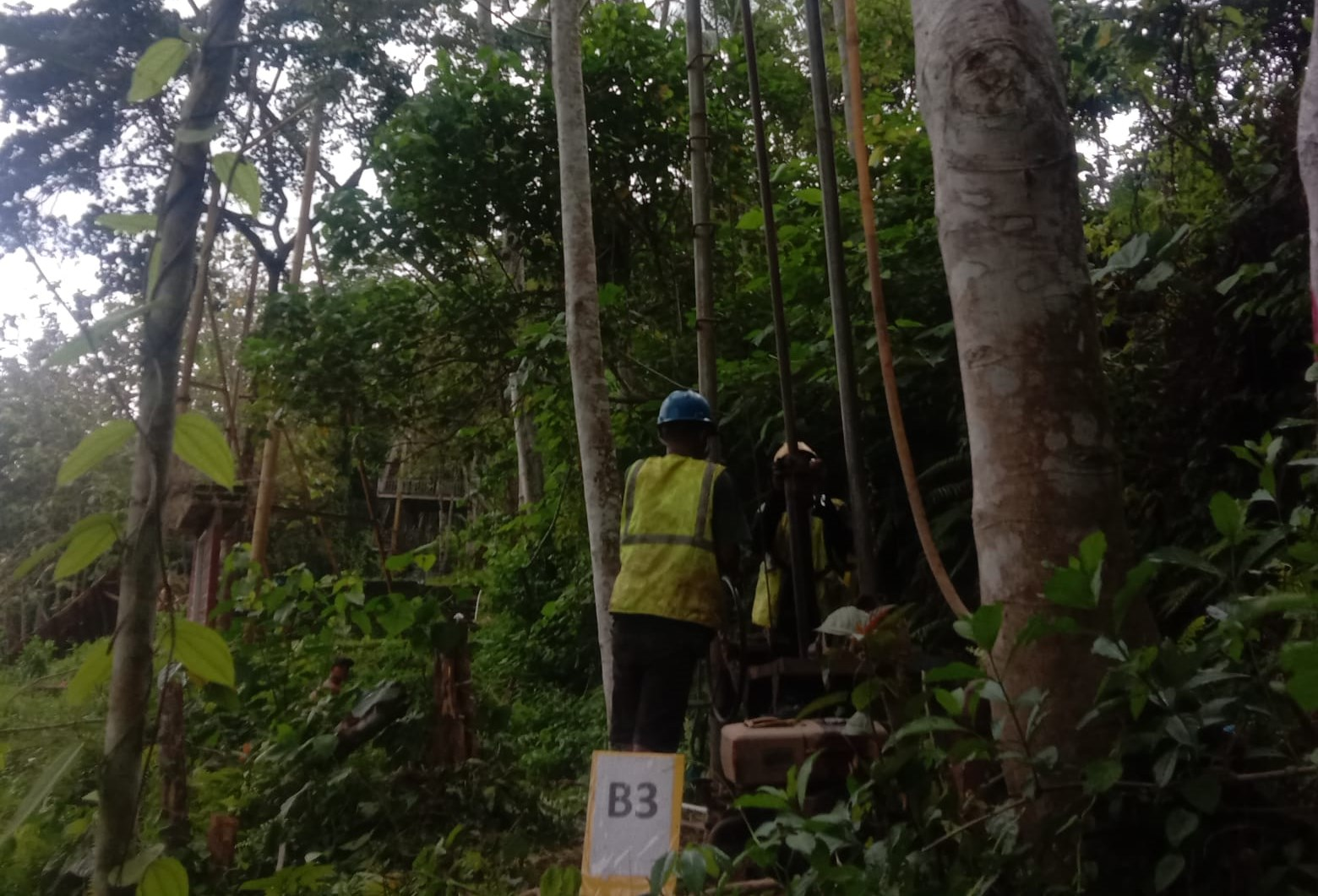
The Standard Penetration Test (SPT) involves drilling a borehole and driving a split-barrel sampler into the soil at set intervals. It produces both N-values and physical soil samples for laboratory analysis. As described in ASTM D1586/D1586M, this is the most frequently used subsurface exploration drilling test worldwide, and it is essential for projects requiring deep foundation design or classification of clay and mixed-layer profiles.
Additional methods include geoelectric resistivity survey, which maps aquifers and subsurface voids non-invasively, and Ground Penetrating Radar (GPR), which detects buried utilities and shallow structural anomalies. Indo Soil provides all of these methods using modern electronic equipment calibrated to international standards.
Understanding CPT: Function and Procedure in Bali
Electromechanical vs Mechanical Sondir CPT in Bali
Boring Test Guide: Procedure and Foundation Interpretation
The Complete Soil Test Process: From Site Visit to Final Report
Understanding how a soil investigation unfolds helps you plan your project timeline and coordinate with your architect and structural engineer. The process follows a clear sequence that Indo Soil applies consistently across all projects.
First, you submit your site location and project brief to Indo Soil. The team reviews the area, identifies the dominant soil type based on regional geology, and recommends the appropriate method or combination of methods. Second, the Indo Soil field team mobilises equipment to your site and conducts the investigation, which for a standard three-point CPT package typically takes one working day on site.
Third, the collected data is processed and interpreted by experienced engineers. The final certified report is delivered in English and Bahasa Indonesia, in PDF and CAD formats, within 5 to 7 working days of the field investigation. The report includes a subsurface profile, bearing capacity values at relevant depths, foundation type recommendations, and any specific risk notes such as liquefaction potential or soft layer identification.
Professional Soil Test Bali: Sampling Procedures Explained
How to Determine Optimal CPT Test Point Spacing in Bali
Have Questions About the Soil Test Process?
Our team is ready to walk you through the entire investigation sequence for your specific site. This complete soil test guide only gets better with a direct conversation. Contact Indo Soil for a free consultation today.
Soil Test Pricing and Packages in Bali
Transparent pricing is one of the principles Indo Soil applies across all its service packages. The table below outlines the standard packages available for Bali projects. All packages include certified reports with no hidden fees.
| Package | Price (IDR) | What Is Included | Best Suited For |
|---|---|---|---|
| Basic Soil Test | Rp 4,000,000 | 3 CPT points (0 to 5 m), PDF report with foundation recommendation in English and Bahasa Indonesia, delivered in 5 to 7 working days | Villas, residential plots, initial planning |
| Business Starter | Rp 7,500,000 | 3 CPT points + topographic survey, complete technical report in PDF and CAD (DWG) format in English and Bahasa Indonesia | Commercial developments, boutique hotels, mixed-use sites |
| Topographic Survey | Rp 4,500,000 | GPS/Total Station land elevation survey, DWG and PDF output, contour lines, spot levels, and benchmark points | Hillside sites, drainage planning, cut and fill design |
| Custom Investigation | Contact for quote | Boring test (SPT), geoelectric survey, GPR, slope stability analysis, or any combination required by project scope | Resort developments, cliff-edge sites, complex geological conditions |
How to Read and Use Your Soil Test Report
A certified soil test report contains several key sections that directly inform your engineering team’s decisions. Understanding the structure of the report helps you communicate more effectively with your architect, structural engineer, and contractor.
The soil profile section presents a graphical and tabular record of soil layers by depth, along with the recorded tip resistance (qc) and friction ratio (Rf) values at each point. From these values, your engineer derives the allowable bearing capacity of the soil at the depths relevant to your foundation design. The report also includes a foundation recommendation section that specifies whether shallow foundations, deep pile foundations, or soil improvement are appropriate for your site.
If your land is near the coast or in a seismically active zone, the report will include a liquefaction assessment. According to the USGS, liquefaction occurs when loosely packed, water-logged sediments lose their strength during ground shaking, which can cause major structural damage during earthquakes. The CPT data that Indo Soil collects enables a quantitative assessment of this risk at your site.
How Well Do Soil Test Recommendations Match Field Conditions?
What Every Bali Property Investor Must Know About Soil Conditions
Soil Testing for SLF and PBG Building Permits
If you are constructing a building in Bali that requires a PBG or SLF permit, you will need to submit geotechnical documentation as part of the technical package to local authorities. A certified soil test report from a professional firm satisfies this requirement. Without it, your application will be incomplete.
Indo Soil produces reports that are formatted to meet the technical documentation standards required for permit submissions. All reports are signed by qualified engineers and carry company certification. Delivering within 5 to 7 working days, Indo Soil also supports fast-track projects where permit timelines are tight.
How Soil Testing Protects Your Property Investment in Bali
Why Clients Choose Indo Soil for Soil Testing in Bali
Soil Testing for Different Project Types in Bali
The appropriate investigation scope varies considerably depending on your project type. The table below provides a practical guide for matching your project to the right method and report depth.
| Project Type | Recommended Method | Typical Depth | Key Deliverable |
|---|---|---|---|
| 1 to 2 storey villa | CPT / Sondir | 0 to 10 m | Bearing capacity, shallow foundation recommendation |
| Multi-storey commercial building | Boring (SPT) + lab testing | 15 to 30+ m | Pile design parameters, N-value profile, lab results |
| Resort on cliff or hillside | CPT + geoelectric + slope analysis | 0 to 20 m | Void detection, slope stability factor of safety |
| Coastal villa (Seminyak, Canggu) | CPT with piezocone | 0 to 20 m | Liquefaction assessment, pile depth recommendation |
| Infrastructure or large development | CPT + boring + topographic survey | 20 to 40 m | Full geotechnical report with design parameters |
| Land acquisition / pre-purchase | Basic CPT | 0 to 5 m | Quick soil profile for investment risk assessment |
Applicable International Standards for Soil Testing in Bali
Professional soil testing in Bali references both Indonesian national standards (SNI) and internationally recognised technical standards. When you engage Indo Soil, your investigation follows documented protocols that are consistent with the following frameworks.
The ASTM D5778-20 standard governs electronic friction cone and piezocone penetration testing, which is the basis of Indo Soil’s digital CPT service. The ASTM D1586/D1586M standard covers Standard Penetration Testing and split-barrel sampling, which applies to all boring work conducted by Indo Soil. Additionally, the ISSMGE TC102 Site Characterization Committee provides the global framework within which in-situ testing best practices are continuously developed and disseminated.
These references ensure that your geotechnical data is internationally valid, interpretable by any qualified structural engineer, and suitable for permit submissions and professional liability purposes.
Ultimate Bali Soil Testing Guide for Coastal and Cliff Construction Projects
How to Avoid Contractor Disputes Caused by Soil Issues in Bali
Start Your Soil Investigation Today
Whether you are planning a villa, resort, or large development, this complete soil test guide gives you the foundation you need. Indo Soil is ready to handle your investigation from consultation to certified report delivery.
Conclusion
This complete soil test guide for Bali has covered the full scope of what you need to know before, during, and after a geotechnical investigation. From understanding why soil testing is non-negotiable in Bali’s seismic and geological context, to selecting the right method for your project, reading your report, and using it for permits and foundation design, every step has a direct impact on the safety and success of your build.
Indo Soil brings together 10 years of field experience across Bali, Lombok, NTB, and NTT, modern electronic equipment, international technical standards, and certified bilingual reporting. Whatever your project type or site location, you can reach Indo Soil for a free consultation and a tailored investigation plan. Contact Indo Soil today and build your project on real data.
Frequently Asked Questions
Q1: What is the most important first step in the complete soil test process for Bali?
The most important first step is to identify your site location and project type so that the correct investigation method can be selected. Coastal sites, cliff sites, hillside plots, and inland lowlands all require different approaches. Contacting a professional geotechnical firm such as Indo Soil before engaging your architect ensures that the soil data informs the design from the very beginning.
Q2: How long does it take from investigation to receiving the complete soil test report?
Field testing for a standard CPT package is typically completed in one working day on site. Report preparation and delivery by Indo Soil takes 5 to 7 working days from the date of testing. For projects requiring boring test laboratory analysis, additional time may apply, which Indo Soil will confirm when agreeing on the project scope.
Q3: Is a soil test required for a small villa in Bali?
Yes. Even small residential buildings in Bali require a soil test, both for structural safety and for permit applications. Bali’s soil variability means that even a single-storey villa on apparently flat land may sit on soft clay, saturated sand, or a variable volcanic profile. A basic CPT package starting at Rp 4,000,000 is sufficient for most residential projects and provides all the data your engineer needs.
Q4: Can I use one soil test report for multiple projects on adjacent plots?
Generally, no. Each plot must have its own investigation because soil conditions can change significantly within a short horizontal distance, especially in coastal and volcanic areas. Using data from an adjacent plot introduces risk that your structural engineer cannot quantify or take professional responsibility for. Each investigation must be site-specific.
Q5: Does Indo Soil service areas outside of Bali?
Yes. Indo Soil operates across Bali, Lombok, NTB, and NTT. The team mobilises to any site in these regions and delivers reports in English and Bahasa Indonesia. Whether your project is in Seminyak, Pecatu, Ubud, Mataram, or a remote location in East Nusa Tenggara, Indo Soil can conduct the investigation and deliver a certified geotechnical report within the standard turnaround period.
