
Many developers and property owners in Bali face delays when applying for PBG and SLF permits because their geotechnical data is incomplete, non-compliant, or missing altogether. This guide explains exactly how to process PBG and SLF permits in Bali with the right soil investigation data, so your application moves forward without costly setbacks.
If you are planning a construction project in Bali, understanding the connection between how to process SLF PBG Bali requirements and your soil test report is the single most important step before you submit anything to the relevant authorities.
What Are PBG and SLF?
PBG (Persetujuan Bangunan Gedung) is the Building Approval that replaced the old IMB permit under Government Regulation No. 16 of 2021. It is required before any construction, modification, or expansion of a building can legally begin. Without a valid PBG, your structure is considered unauthorised under Indonesian law.
SLF (Sertifikat Laik Fungsi) is the Certificate of Function Worthiness issued after construction is complete. It confirms that the building meets all technical and safety standards and is legally approved for occupancy or operation. According to Indonesian regulations, no building can be legally operated without a valid SLF.
Both permits are processed through the national digital platform SIMBG (Sistem Informasi Manajemen Bangunan Gedung), managed by the Ministry of Public Works and Housing. Your soil investigation report is one of the mandatory technical documents required at the PBG application stage.
Geotechnical Data Requirements for PBG
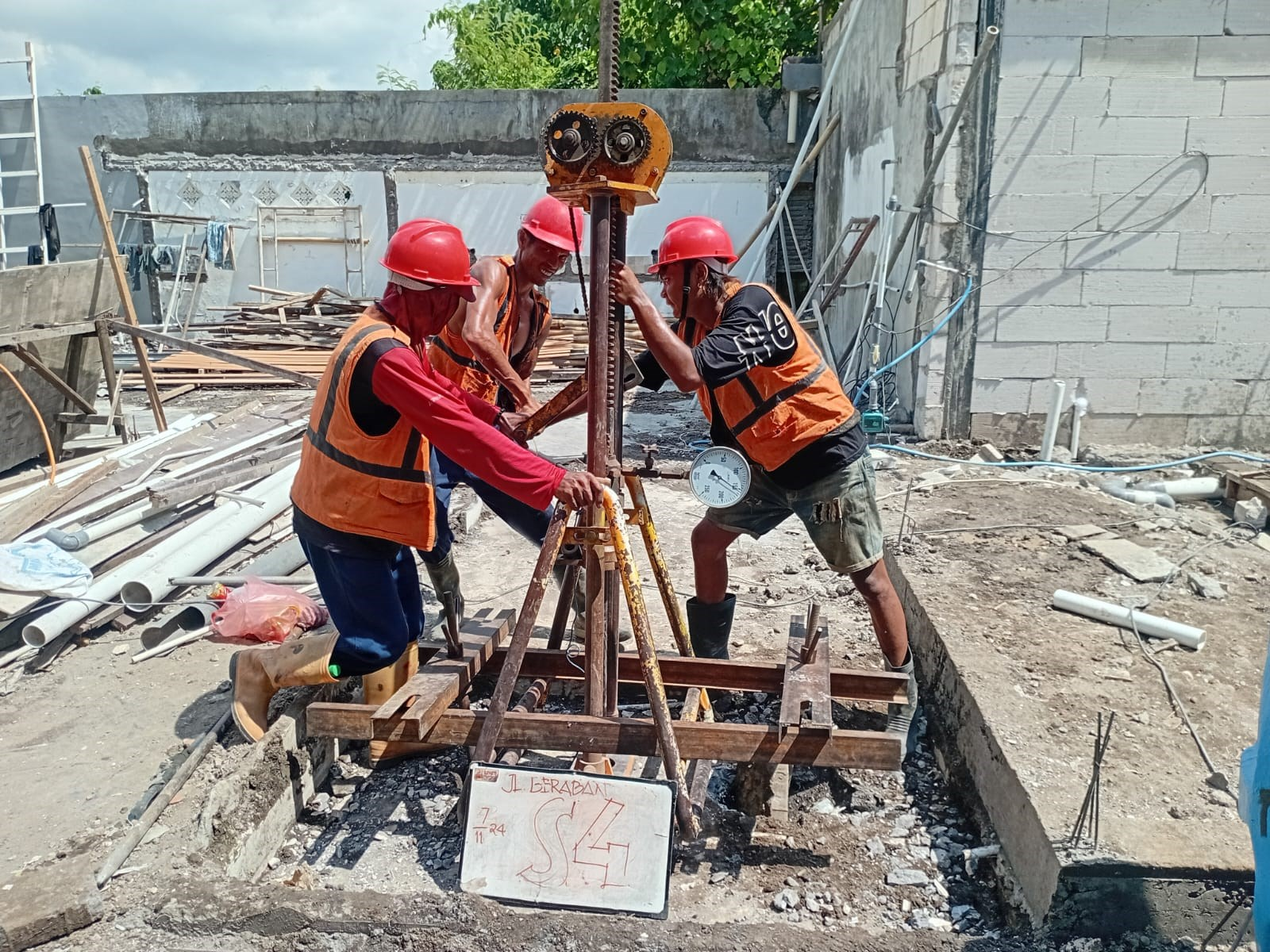
To obtain a PBG, your technical submission must include a complete geotechnical investigation report. This document must demonstrate the soil profile, bearing capacity, and foundation recommendations prepared by a qualified geotechnical engineer. A soil report that is incomplete or prepared by an uncertified party will be rejected by the technical reviewer.
According to Eurocode 7 (EN 1997-1), geotechnical investigation must precede all design decisions for any structure, as subsurface conditions directly determine the appropriate foundation system. This international standard aligns with what Indonesian authorities expect in a compliant PBG soil report.
The geotechnical report submitted for PBG in Bali must typically include soil stratigraphy, allowable bearing capacity at the foundation depth, groundwater level data, and a foundation type recommendation. A report that only shows surface observations without field test data such as CPT or SPT results will not satisfy the technical review stage.
Types of Soil Test Reports Accepted by Agencies
Not all soil test formats are accepted for PBG and SLF purposes. The report must be based on recognised field testing methods that produce quantitative data. Below is a summary of the test types most commonly accepted by building authorities in Bali and across Indonesia.
| Test Type | International Standard | What It Measures | Accepted for PBG |
|---|---|---|---|
| CPT / Sondir | ASTM D5778 | Cone resistance, friction ratio, soil layer depth | Yes |
| Boring Test (SPT) | ASTM D1586 | N-value, soil sample, stratigraphy | Yes |
| Laboratory Analysis | ASTM D2487 (USCS) | Grain size, Atterberg limits, shear strength | As supplement |
| Hand Auger / Visual Survey | None standardised | Surface observation only | Not accepted |
| CPT + Lab (combined) | ASTM D5778 + D2487 | Full soil profile with strength parameters | Yes (preferred) |
The International Society for Soil Mechanics and Geotechnical Engineering (ISSMGE) recognises CPT as the most efficient field method for obtaining continuous subsurface data, particularly in soft soil conditions common in coastal Bali. A report based on CPT data provides the clearest picture of bearing capacity at each depth.
The FHWA Geotechnical Engineering Circular No. 5 also confirms that CPT and SPT are the two primary in-situ test methods for evaluating soil properties intended for foundation design. Authorities reviewing your PBG submission expect to see at minimum one of these two methods applied on your land.
Steps to Properly Process PBG and SLF in Bali
Processing your PBG and SLF permits in Bali requires completing the right steps in the right sequence. Skipping or reversing these steps is one of the most common reasons applications are delayed or rejected.
First, conduct your soil investigation before preparing any architectural or structural drawings. Your structural engineer needs the bearing capacity data from your soil report to design the correct foundation system. Submitting drawings without soil data means your engineer is guessing, and the reviewer will know.
Second, use your certified soil report to finalise the structural design. The foundation type, pile depth, and load calculations must all be consistent with what your geotechnical report states. Any inconsistency between the structural drawing and the soil report will trigger a revision request during technical review.
Third, register your application on the SIMBG portal and upload all technical documents including your soil report, architectural drawings, structural calculations, and supporting permits. Ensure that your geotechnical report is signed and stamped by a licensed engineer. Unsigned or unstamped reports are a common cause of rejection.
Need a Soil Report That Is Ready for PBG Submission?
Indo Soil produces certified geotechnical reports accepted by relevant agencies in Bali. Our reports include CPT data, bearing capacity analysis, and foundation recommendations in both English and Bahasa Indonesia.
How Long Does the PBG and SLF Permit Process Take?
The SIMBG system is designed to process PBG applications within 28 working days from the date of complete document submission. However, this timeline assumes that your documents are complete and compliant from the first submission. Applications with missing or non-compliant geotechnical data are placed on hold and require revision, which extends the timeline significantly.
The SLF is issued after construction is complete and a final inspection confirms that the building matches the approved PBG design. This inspection and issuance process is also managed through SIMBG. For residential buildings, the SLF is valid for 20 years. For commercial structures, it requires renewal every 5 years.
| Stage | Timeframe | What You Need Ready | Common Delay Factor |
|---|---|---|---|
| Soil Investigation | 1-2 working days on site | Access to land, Indo Soil team | Land access restrictions |
| Soil Report Delivery | 5-7 working days | Test data, engineer sign-off | Incomplete test points |
| Structural Design | 7-14 working days | Certified soil report, architect drawings | Soil report not ready first |
| PBG Application (SIMBG) | Up to 28 working days | All technical documents uploaded | Missing or unsigned geotechnical report |
| SLF Issuance | After construction + inspection | Building matches approved PBG | Deviations from approved design |
Common Mistakes That Delay the PBG and SLF Process
Understanding what goes wrong for other developers is one of the fastest ways to protect your own application. The following mistakes consistently cause PBG and SLF delays in Bali, and all of them are preventable.
The most frequent mistake is submitting structural drawings before completing the soil investigation. When a structural engineer designs a foundation without bearing capacity data, the foundation assumptions often fail technical review. The reviewer will request revisions, which means the structural engineer must redo the calculations after the soil test is finally done, adding weeks to your timeline.
Another common mistake is using a soil report that covers only one test point for a large or irregular plot. According to ISSMGE guidelines on CPT application, subsurface conditions on a single plot can vary significantly, particularly in coastal and volcanic soil environments. A single test point does not give a complete picture and may be flagged by the technical reviewer.
A third mistake is submitting a report prepared by an uncertified party. In Indonesia, geotechnical reports submitted for PBG must be produced by engineers who hold valid professional certification. A report from an uncertified provider carries no legal standing and will be rejected at the review stage.
10 Fatal Mistakes That Happen Without Soil Testing
How to Avoid Contractor Disputes Caused by Soil Issues in Bali
Indo Soil: Ready-to-Use Reports for PBG and SLF
Indo Soil produces certified geotechnical reports that meet the technical documentation requirements for PBG and SLF applications in Bali. Our reports include a complete CPT soil profile, bearing capacity analysis at the required foundation depth, groundwater level data, and specific foundation type recommendations. Every report is signed and stamped by a licensed geotechnical engineer.
Furthermore, our reports are delivered in both English and Bahasa Indonesia in PDF and CAD formats within 5 to 7 working days of completing fieldwork. This turnaround means you can move directly from soil investigation to structural design without delays. We serve clients across Bali, Lombok, NTB, and NTT, and our reports have been accepted by relevant technical agencies for PBG submissions across these regions.
Additionally, we provide a pre-submission review service. If your structural engineer has questions about the soil data, our team is available to provide technical clarification and supplementary calculations as needed. This support reduces revision cycles and keeps your permit application on track.
Why Clients Choose Indo Soil for Soil Testing in Bali
How Soil Testing Protects Your Property Investment in Bali
What Every Bali Property Investor Must Know About Soil Conditions
Indo Soil Service Packages for PBG and SLF Support
The following packages are designed to support PBG and SLF applications at different project scales. All packages include a certified report delivered within 5 to 7 working days. There are no hidden costs.
| Package | Price (IDR) | Includes | Best For |
|---|---|---|---|
| Basic Soil Test | Rp 4,000,000 | 3 CPT points (0-5 m), PDF report in English and Bahasa Indonesia, foundation recommendation | Small villas, initial PBG planning |
| Business Starter | Rp 7,500,000 | CPT 3 points + topographic survey, PDF and CAD (DWG) output, full technical report | Commercial projects, mid-size developments |
| Topographic Survey | Rp 4,500,000 | GPS/Total Station survey, DWG + PDF, benchmark points, contour mapping | Site layout planning, drainage design |
| Custom Project | Contact for quote | Boring test (SPT), geoelectric survey, slope stability analysis, multi-point CPT | Resorts, cliff sites, complex terrain, large developments |
Indo Soil Professional Soil Testing Services in Bali
Geotechnical Analysis for Luxury Cliff Villas in Bali
Soil Test Investigation: Pecatu, South Kuta, Bali
Conclusion
Processing your PBG and SLF permits in Bali does not need to be complicated, provided your geotechnical data is complete, compliant, and submitted in the correct order. The most important action you can take is to conduct a proper soil investigation before any structural design begins. This single step eliminates the most common causes of permit delays and revision requests.
Indo Soil is ready to support your project from the first soil test to the final certified report. With over 100 completed projects and more than 3,000 hectares of land surveyed across Bali, Lombok, NTB, and NTT, we have the experience to get your documentation right the first time. Contact Indo Soil today for a free consultation and let us help you move your permit application forward with confidence.
Frequently Asked Questions
Q1: Is a soil investigation report mandatory for PBG in Bali?
Yes. A soil investigation report containing bearing capacity data and foundation recommendations is required as part of the technical documents submitted for PBG through the SIMBG portal. Submitting drawings without this report will result in your application being placed on hold.
Q2: Can I use an old soil report from a previous owner for my PBG application?
This depends on the date, scope, and certification of the original report. If the report is more than 5 years old, does not cover your specific plot, or was not signed by a licensed engineer, it is unlikely to be accepted. Indo Soil recommends conducting a new investigation to ensure your submission is current and compliant.
Q3: What is the difference between CPT and SPT for PBG purposes?
A CPT (Cone Penetration Test) pushes a sensor into the ground continuously and records resistance at every depth without extracting samples. An SPT (Standard Penetration Test) drills a borehole and collects soil samples at intervals. Both methods are accepted for PBG in Bali. CPT is faster and provides a continuous soil profile, while SPT is preferred when physical samples are needed for laboratory analysis.
Q4: How many CPT test points are needed for a PBG soil report in Bali?
The minimum number of test points depends on the plot size and building type. For a small villa plot, 3 CPT points at standard depth are generally sufficient. Larger or more complex sites require additional points to capture soil variability across the land. Indo Soil will recommend the appropriate number of test points based on your project scope. Read more about CPT test point spacing in Bali.
Q5: Can Indo Soil assist if my PBG application has already been rejected due to incomplete geotechnical data?
Yes. Indo Soil regularly assists clients who are in the revision stage of their PBG application. We can conduct additional soil tests, produce a supplementary report, or prepare a complete new geotechnical report to meet the requirements of the technical reviewer. Contact us through WhatsApp or the Indo Soil contact page to discuss your situation.
