
When you plan to build a villa in Bali, one of the first technical decisions you need to make is choosing the right CPT vs SPT soil test method. Both are widely accepted in geotechnical engineering, but each one is designed for a different purpose, depth range, and site condition. Choosing incorrectly can lead to incomplete data, project delays, or worse, an unsafe foundation.This article gives you a clear, honest comparison of both methods so you can make an informed decision before breaking ground.
The CPT vs SPT soil test method debate is not simply about which one is better. It is about which one is right for your specific land, your project size, and your engineering requirements. Understanding how each method works is the first step toward building safely in Bali.
#1: Overview of CPT and SPT
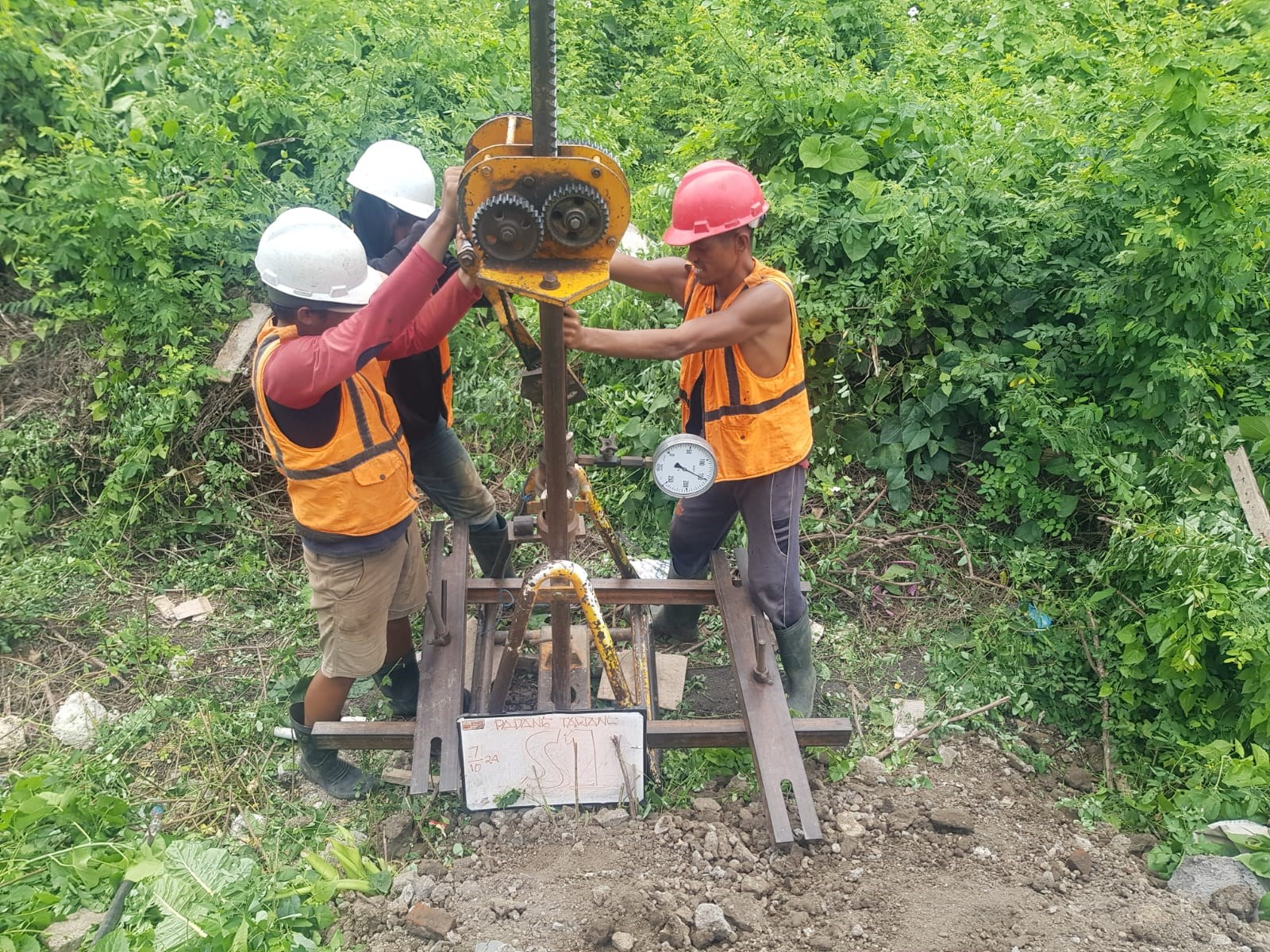
The Cone Penetration Test (CPT), also known as the Sondir test in Indonesia, is conducted by pushing a cone-tipped rod into the ground at a constant rate while recording resistance continuously at each depth. According to ASTM D5778-20, the electronic friction cone and piezocone penetration test provides a detailed record of cone tip resistance, which is useful for evaluating site stratigraphy, engineering properties, and depth to firm layers.
The Standard Penetration Test (SPT), on the other hand, involves drilling a borehole and driving a split-barrel sampler into the soil using a drop hammer. As described in ASTM D1586, SPT is the most frequently used subsurface exploration drilling test performed worldwide. It provides both a penetration resistance value (N-value) and physical soil samples for laboratory analysis.
Both methods serve the same core goal: understanding what lies beneath your land. However, the approach, output, and ideal application differ significantly between the two.
#2: Technical Specifications of Each Method
Understanding the technical side of the CPT vs SPT soil test method helps you communicate better with your engineer and avoid unnecessary testing costs. The table below summarises the key specifications of each method.
| Specification | CPT / Sondir | SPT (Boring Test) |
|---|---|---|
| Testing standard | ASTM D5778, SNI 2827:2008 | ASTM D1586, SNI 4153:2008 |
| Data type | Continuous cone resistance and friction ratio | N-value per depth interval + soil samples |
| Typical depth range | 0 to 30 metres | 5 to 30+ metres |
| Soil sampling | No physical samples collected | Disturbed soil samples collected |
| Test duration on site | Half to one working day (3 points) | One to several days depending on depth |
| Cost level | Lower | Higher |
| Best for | Soft soil profiling, shallow to mid-depth | Deep layers, laboratory testing needed |
#3: Accuracy and Data Quality
One of the most common questions property owners ask when comparing the CPT vs SPT soil test method is which one gives more accurate data. The answer depends on what type of accuracy you need. CPT produces continuous data from the surface down to the target depth, recording a measurement at every 2 centimetres. This gives your engineer a highly detailed soil profile without any gaps.
SPT, by contrast, takes measurements at intervals, typically every 1.5 metres. While less continuous, SPT provides something CPT cannot: actual physical soil samples. These samples can be sent to a laboratory for testing parameters such as grain size distribution, plasticity index, and shear strength. According to the International Society for Soil Mechanics and Geotechnical Engineering (ISSMGE), selecting the appropriate in-situ test depends on site conditions, project requirements, and the level of geotechnical data needed for safe design.
#4: Advantages of CPT for Villa Projects
For most villa and residential projects in Bali, CPT offers clear advantages. First, CPT testing is significantly faster than SPT. A standard 3-point CPT can typically be completed in a single working day on site. This makes it the preferred method when your project timeline is tight and you need a certified soil test report quickly for building permit applications such as PBG and SLF.
Second, CPT data is continuous and precise. Because the cone records resistance at every 2 centimetres of penetration, your engineer receives an uninterrupted picture of every soil layer from the surface down to the target depth. This level of detail makes CPT particularly well-suited for identifying soft clay layers, loose sand zones, and transition depths that might affect your foundation design. Indo Soil uses digital electronic CPT equipment that meets the standards set out in ASTM D5778-20, ensuring that data quality is consistent across every test point.
Third, CPT is more affordable than SPT, which means you can test more points across your land for the same budget. More test points translate to a more complete understanding of your site variability.
Electromechanical vs Mechanical Sondir CPT in Bali
How to Determine Optimal CPT Test Point Spacing in Bali
#5: Advantages of SPT for Complex Projects
While CPT excels in efficiency, SPT remains indispensable for certain project types. The most significant advantage of SPT is that it produces actual soil samples. These samples allow your geotechnical laboratory to determine plasticity limits, grain size distribution, and other critical properties that cannot be inferred from cone resistance alone. For projects involving heavy structures, deep foundations, or sites with unusual soil conditions, laboratory-tested samples are often required by your structural engineer.
SPT is also better suited for penetrating stiff or gravelly soil layers where a CPT cone may refuse to advance. In addition, SPT can reach depths exceeding 30 metres when needed, making it the right choice for high-rise structures, resorts, and large commercial developments. Eurocode 7 (EN 1997) requires that geotechnical investigation be proportional to the complexity and risk level of the structure, which means heavier and taller structures typically require more comprehensive ground investigation including SPT.
Not Sure Which Method Your Land Needs?
The Indo Soil team will assess your site conditions and recommend the most appropriate soil test method for your project. No commitment required.
#6: CPT vs SPT Soil Test Method by Project Type
Choosing between the CPT vs SPT soil test method ultimately comes down to your project type, your site conditions, and the depth of investigation required by your structural engineer. The comparison table below provides a practical guide based on the most common construction scenarios in Bali.
| Project Type | Recommended Method | Reason | Typical Depth |
|---|---|---|---|
| 1-2 storey private villa | CPT / Sondir (3 points) | Sufficient for shallow foundation design; fast and affordable | 0 to 15 m |
| 2-3 storey villa with basement | CPT + SPT combination | CPT for profiling, SPT for lab samples and deeper layers | Up to 20 m |
| Luxury cliff villa | CPT + SPT + slope analysis | Complex terrain requires full investigation and stability report | Up to 25 m |
| Small commercial building | CPT (3-5 points) | Multiple test points needed to map variability across the site | 0 to 20 m |
| Resort or hotel development | SPT + CPT + lab analysis | Heavy structures require physical sample testing and deep profiling | 20 to 30+ m |
| Coastal or reclaimed land | CPT + piezocone (CPTU) | Pore water pressure monitoring essential for liquefaction assessment | 0 to 25 m |
#7: What Happens When You Skip the Soil Test
Some property owners still attempt to skip the CPT vs SPT soil test method decision altogether by proceeding without any ground investigation. This is one of the most costly mistakes you can make. Without a certified soil test, your structural engineer is forced to make assumptions about the bearing capacity of your land. Those assumptions often result in over-designed foundations that cost far more than the test itself, or, more dangerously, under-designed foundations that fail over time.
In Indonesia, geotechnical data is a mandatory part of the technical documentation required for PBG and SLF permit applications. A soil test report from a certified firm is required before permits are issued. Beyond the regulatory requirement, the data you receive directly shapes how your architect and engineer plan your building. Starting construction without it means every subsequent decision about your foundation is based on guesswork rather than evidence.
10 Fatal Mistakes That Happen Without Soil Testing
How Soil Testing Protects Your Property Investment in Bali
#8: Indo Soil Service Packages and Pricing
Indo Soil provides transparent, fixed-price packages for soil testing in Bali, Lombok, NTB, and NTT. All packages include a certified report in both English and Bahasa Indonesia, delivered within 5 to 7 working days. The table below outlines the most commonly requested packages.
| Package | Price (IDR) | Includes | Best For |
|---|---|---|---|
| Basic Soil Test | Rp 4,000,000 | 3 CPT points (0-5 m), PDF report, foundation recommendation | Small villas, initial planning |
| Business Starter | Rp 7,500,000 | CPT 3 points + topographic survey, PDF and CAD output | Commercial and mid-size projects |
| Topographic Survey | Rp 4,500,000 | GPS/Total Station, DWG + PDF, benchmark points | Slope, drainage, and layout design |
| Custom / Large Projects | Contact for quote | Boring test (SPT), geoelectric, GPR, slope stability analysis | Resorts, cliff sites, complex terrain |
Professional Soil Test Bali: Sampling Procedures Explained
Geotechnical Analysis for Luxury Cliff Villas in Bali
Conclusion
When you compare the CPT vs SPT soil test method, there is no universal winner. CPT is faster, more affordable, and provides highly detailed continuous data, making it the preferred starting point for most villa projects in Bali. SPT is deeper, produces physical samples, and is essential for complex, large, or heavy structures that require laboratory analysis.
For most 1 to 3 storey villas, CPT alone is sufficient. For larger developments or challenging terrain such as cliff sites and coastal land, a combination of CPT and SPT delivers the most complete picture of your site. The most important step is not to skip the soil test entirely. Every property in Bali deserves a professional ground investigation before construction begins.
Indo Soil has completed over 100 projects and surveyed more than 3,000 hectares across Bali, Lombok, NTB, and NTT. Our team is ready to recommend the right method for your land and deliver a certified report in under 7 working days. Contact Indo Soil today for a free consultation and let us help you build with confidence.
What Every Bali Property Investor Must Know About Soil Conditions
Why Clients Choose Indo Soil for Soil Testing in Bali
Frequently Asked Questions
Q1: Which is more accurate for soft soil in Bali, CPT or SPT?
CPT is generally more accurate for soft soil profiling because it records resistance continuously at every 2 centimetres of depth. This makes it ideal for identifying thin soft clay layers that SPT might miss between its sampling intervals. For soft coastal or alluvial soil in Bali, CPT is the preferred first method.
Q2: Can I use CPT data alone to design my villa foundation?
Yes, for most 1 to 2 storey villas, CPT data is sufficient for foundation design. Your structural engineer can derive bearing capacity values and pile depth recommendations directly from CPT cone resistance and friction ratio data. For heavier or deeper structures, your engineer may additionally require SPT samples for laboratory testing.
Q3: How long does each test take on site in Bali?
A standard 3-point CPT can typically be completed in half a day to one full working day on site. SPT boring takes longer, often one to several days depending on the number of boreholes and the depth required. Indo Soil delivers certified reports within 5 to 7 working days from the date of field testing.
Q4: Is the CPT vs SPT soil test method choice affected by building permit requirements in Bali?
Yes. For PBG and SLF permit applications in Indonesia, your geotechnical report must include sufficient data to support foundation design. For standard villas, a CPT report from a certified firm is typically accepted. For larger structures or sites with complex conditions, local authorities or your structural engineer may require SPT data as well.
Q5: Does Indo Soil offer both CPT and SPT services?
Yes. Indo Soil provides CPT/Sondir testing, boring test (SPT), topographic survey, geoelectric survey, GPR survey, and slope stability analysis across Bali, Lombok, NTB, and NTT. For projects that require a combination of methods, our team will recommend the most cost-effective package based on your site conditions and project requirements. View all Indo Soil services here.
